Monday, March 10, 2025

CCR Question #2 Research

Hey blog!

Today I'm going to be researching for my second question of the Creative Critical Reflection. 

The second question is "Question 2: How does your product engage with audiences, and how would it be distributed as a real media text?" 

I think, like last time, the best way to research how to answer this question is by breaking it down into subquestions and then researching to answer them thoughtfully.

Here goes!

1. Who is our primary target audience, and which aspects of the film specifically cater to them?

Our primary target audience is teenagers and young adults (13-21 years old), particularly those interested in sports and humor.

A Pew Research Center survey shows that nearly half of US teens are "almost constantly" online, with platforms Youtube and Tiktok being the most popular among that group.

This implies that they prefer faster-paced, more engaging content. Earlier in the year, I also did research on teen audiences when doing research for my Music Video project and its persona, Richie Stein. One of Richie Stein's core values was authenticity because I found in my research that teens value authenticity and emotional depth.

Our film would be engaging to a teen audience because it balances humor with an emotionally grounded underdog story (I researched the "underdog effect" in my last post) and because it incorporates fast-paced storytelling and authenticity with its characters and their struggles.

It deals with a type of identity problem that certain teens may specifically struggle with, but the process of individuation itself is something that teens, young adults, and even adults alike all deal with, making it relatable.

2. How do we hook modern teen viewers with short attention spans right from the start?

Researchers at Microsoft found almost 10 years ago that our average attention span when consuming digital content was now 8 seconds. With the rise of short-form infinite scroll social media platforms like TikTok, I'd estimate that this has only reduced, and given the earlier research on how much US teens use these platforms as well as what I've observed myself, I'd say that in teens it's less than 8 seconds. 

To combat this, our film drops the audience right in the action opening in media res, which I explored in my blogs when researching approaches to filmmaking. We also have fast-paced editing, cutting quickly between movements and we employ unexpected humor with the actual airball, giving a "payoff" of sorts in the middle of our opening, rewarding the viewer and encouraging them to keep watching.

3. Which online platforms are best suited for distributing a student-created film?

Given that Airball is a student film, a theatrical release isn't initially realistic, and we'd focus on platforms with:

- A large teen audience

- Free to distribute

- Encourage engagement, community, sharing, etc.

This makes YouTube the obvious choice for a primary platform. It allows for free distribution, potential virality, and a video that's 2 minutes long in a horizontal format. The aforementioned Pew Research Survey also showed that it's the most used platform by teens.

However, to market our film we'd also use Tiktok and Instagram Reels to capture more of the teen audience and increase chances of going viral. Tiktok and Instagram are the second and third most used platforms by teens and make going viral simple. We could post clips from our film, behind the scenes, etc.

We could also submit our film to film festivals and gain exposure beyond social media.

4. What promotional strategies could drive viewers to actually watch and share the opening?

Leveraging social media by sharing funny clips from the movie is our best bet. Clips like the actual airball sequence and the subsequent reactions from the other players are actually funny and have potential to go viral. 

Once we get some money (whether that be from crowdfunding, ad revenue, sponsorships), we could even pay people to post clips on these shortform platforms on a CPM model. Instead of traditional advertising where CPMs (cost per thousand views) are a few dollars, we could pay a few cents per thousand views to creators and drive organic virality. 

Hopefully that's enough to answer Question 2, see you next time with Question 3!

Works Cited:

McSpadden, Kevin. “Science: You Now Have a Shorter Attention Span than a Goldfish.” Time, Time, 14 May 2015, time.com/3858309/attention-spans-goldfish/.

“Teens’ Social Media Use Remains High: What Can Parents Do?” Psychology Today, Sussex Publishers, www.psychologytoday.com/us/blog/raising-humans-in-a-digital-world/202312/teens-social-media-use-remains-high-what-can-parents. Accessed 9 Mar. 2025.

Valle, Gaby Del. “The Extremely Online Life of the American Teenager.” The Verge, The Verge, 12 Dec. 2024, www.theverge.com/2024/12/12/24319692/half-of-us-teens-almost-constantly-online-pew-research-poll.


Sunday, March 9, 2025

Editing / Sequencing

 Hey blog!

Today we began editing. Editing will include combining all the best versions of the clips, matching the voiceovers with those clips, adding the credit sequence, music, sound effects, and special effects like the slow mo.

Wyatt from our group will be editing since we split up our responsibilities, but I'm going to be helping him with the vision and providing advice on how to do certain things.

We also had problems hearing JD's mom in the scene where we record from far away so I had her rerecord her line on her phone (phone is fine since we used the phone to record the actual audio anyways, besides the voiceover) and send it to me.

Wyatt laid out all the best versions of the clips in Capcut and put them in order and trimmed them. Here are some screenshots of our sequence. 


There are just a few more effects that need to be added, such as adding the voiceover audio, slow motion, and the music to the gym sequence. 

See you next time!


Saturday, March 8, 2025

CCR Question #1 Research

Hey blog!

Today I'm going to be researching for my first question of the Creative Critical Reflection. 

The first question is "Question 1: How does your product use or challenge conventions and how does it represent social groups or issues?" 

I think the best way to research how to answer this question is by breaking it down into subquestions and then answering them with researched, thoughtful answers.

Here we go!

1. Which conventions define a typical teen sports comedy, and how do they set audience expectations?

Teen sports comedies typically include:
  • An underdog protagonist, like JD in "Airball," who starts off not very skilled, creating a narrative of overcoming odds, much like Daniel in The Karate Kid (1984)


  • A mentor figure, such as Coach Marcus, guiding the protagonist's growth, like Coach Carter from "Coach Carter" (2005) but more comedic and less serious.


  • Focus on friendships or team dynamics, seen in JD's interactions with teammates.

  • Humor from the character's struggles, like JD airballing a shot or struggling to bench the bar.

2. Why focus on personal or family-based pressure instead of a wider social or systemic issue?

Choosing personal or family-based pressure, like JD's struggle with his brother's legacy, keeps the story driven by the character. It also is way more relatable to teens, as according to the abstract of The Development of Self and Identity in Adolescence: Neural Evidence and Implications for a Value-Based Choice Perspective on Motivated Behavior, "Adolescence is crucial for many aspects of developing self and identity, including commitments, personal goals, motivations,[...] and [adolescents] are more concerned with and interested in others’ perceptions of self." Tackling an issue that directly deals with JD's sense of his self is relatable to all teens in some way, as everyone has to go through becoming who they really are. Also on a more fundamental note; given the two-minute runtime, broader social issues would be hard to begin to address. 

3. Which existing underdog stories inspired your approach to representing internal struggle on screen? 

My approach to JD's internal struggle draws from the character of Zuko from"Avatar: The Last Airbender" (redemption arc). These inspire a focus on character development and a man vs self, seen in JD's journey to define himself beyond his brother; although in the opening itself, JD is still locked into the paradigm of proving himself and living up to the standards his brother set. Although not as extreme, mise-en-scene defines both characters. In Airball, the set design with the basketball memorabilia and photo in JD's room manifests his obsession externally, while Zuko's character design includes his iconic scar, he is literally marked by the scar of a banished prince.

Although not directly answering this question, I also found in my research that audiences root for underdogs because we project our struggles onto them. JD as a character is the underdog, and his process of individuation and the struggles that come with it mirrors/represents the teen audience's own struggle broadly, and for some teens (who feel like they're in the shadow of their father/mother/sister/brother) it specifically mirrors their own. 

4. Which conventions do we use or challenge from the researched films? 

We use some norms like the mentor figure (Coach Marcus) and an underdog protagonist (JD) who starts off not very skilled, but instead of making the movie about him overcoming his lack of skill, it would be about how he realizes that he doesn't have to be like his older brother and can forge his own path. The conflict is more internal than external, even if the viewer doesn't realize it themselves at first. 

This should be enough to answer Question 1.

See you next time!

Works Cited:

Pfeifer, Jennifer H, and Elliot T Berkman. “The Development of Self and Identity in Adolescence: Neural Evidence and Implications for a Value-Based Choice Perspective on Motivated Behavior - PMC.” PubMed Central, 8 Feb. 2018, pmc.ncbi.nlm.nih.gov/articles/PMC6667174/.

Stromberg, Joseph. “The Science of Why We Love to Root for Underdogs.” Vox, Vox, 20 Mar. 2015, www.vox.com/2015/3/20/8260445/underdogs-psychology.

Friday, March 7, 2025

Voiceover Production and Editing

 Hey blog!

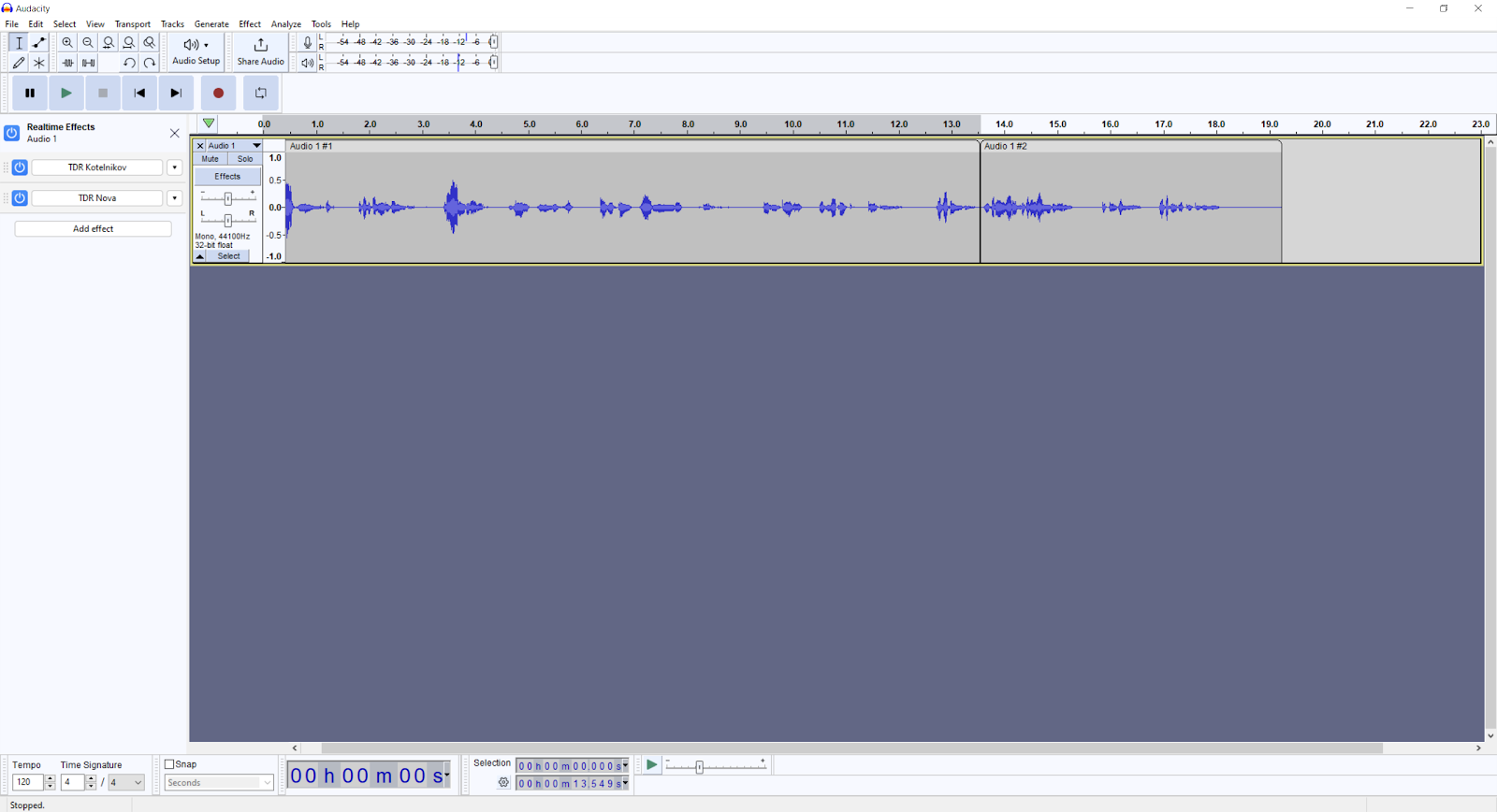
Today we recorded and I edited the voiceover for the first 15-30 seconds of our portfolio project. We recorded it on a HyperX Quadcast microphone using the Audacity software below.


I applied some effects and tweaked them to make the recording sound as professional as possible, using VST plugins TDR Kotelnikov (a compressor) and TDR Nova (an equalizer). 

There was also some background noise which I reduced with Audacity's "Noise Reduction" feature. 


See you next time!

Tuesday, March 4, 2025

Filming the Room and Office Scene

 Hey blog!

Today we filmed the room and office scene. 

For the office scene, there were a few props involved: the signed basketball in its case, the photo we made earlier, and the jerseys and posters in our friend Abe's room. Our friend who I mentioned in the casting post, Kami, played the role of JD's mom. We also were able to incorporate custom lighting as Abe's room had a lighting system (more than just LEDs) he could manipulate on his phone. Here are some stills from the scene.


For the office scene, we were initially planning on getting permission from a teacher to film in our study hall, but we encountered some issues. Gebble, JD's actor and Noah, Coach Marcus' actor don't have the same study hall, so we couldn't film during school. We had more time to resolve this problem throughout the week, but since Abe's house also had a nice office, we decided to use it instead. Here are some stills from that scene.


That's all our scenes!
See you next time


Sunday, March 2, 2025

Producing the Gym Scene

 Hey blog!

Today we produced the gym scene at the same LA Fitness as from last post. However, instead of a shot of Gebble squatting, which was difficult as there were no angles where we could get no people in the background while shooting it, we replaced it with 2 scenes: a treadmill scene and a cycling scene. I'm not sure if we'll need to have both in the production itself, but we got multiple shots/angles of each. We tried to make sure no one was in the background, and if they were, they were completely blurred naturally. The gym did have music playing but the no copyright rap music we selected earlier will be playing, so it's not an issue.

Here are some stills from the production.


See you next time!

Saturday, March 1, 2025

Producing the Basketball Scene

 Hey blog!

Today we recorded the basketball scene. Unfortunately, we came across many challenges this week and we weren't able to actually secure the school basketball gym to ourselves. We had to opt for going to a public gym, (LA Fitness pictured below) getting free three days passes.


There were other people on the other side of the basketball court, so our clips were noisy, but this isn't a super big deal as Gebble will be doing a voiceover during the sequence anyways and any sound effects (shoes screeching, basketball, etc) were probably not captured well regardless and would be better editing in, whether we make foley sounds or not. 

Here are some of the stills from the production.


See you next time!

Links to CCR & Production

 CCR Podcast (Questions 1&2):  https://drive.google.com/file/d/1aAl71x6rmRxnY2iaQ6E3MnXt9LTVIOCi/view?usp=sharing CCR Search History (Qu...